Sometimes, you just need a good old-fashioned worksheet. After all, nothing beats practice and repetition. In this post, I’m going to share active and passive voice worksheets for high school along with other resources.
If you need to teach active and passive voice–and want to skip all of the prep work–you can grab my Active and Passive Voice Writing Skills Lesson right here!

Before Teaching Active and Passive Voice
Before you begin teaching active and passive voice, make sure your students are ready to learn it.
I don’t think it matters if your students are in middle school or high school. Understanding active and passive voice has less to do with age and more to do with students being able to analyze sentence structures.
I like to cover the parts of a sentence and independent and dependent clauses before introducing active and passive voice. (I also like to teach verbals first. That way, students are less likely to confuse the actual verb for a verbal when writing active sentences.)
If students don’t understand these basic terms and parts of sentence structure, they’re not ready for active and passive voice.
How To Teach Active and Passive Voice
Try to hook your students with an interesting pre-thinking exercise. (I share mine below in the next section.)
Then, I recommend briefly showing the difference between active and passive voice. Use several examples, but don’t go too deep just yet.

Focus on having students find the “doer” in each sentence. Once they’ve mastered this skill, then see if they can differentiate between active and passive voice.
This is when active and passive voice worksheets come in.
Having students do some independent work in between instruction sessions will help them apply what they’re learning. If students only listen to you, nothing will stick. Make sure you’re having students complete practice activities like worksheets or task cards as you go.
I also like to cover active and passive voice in questions and commands. (These types of sentences can be harder to break down. Offering different sentences with challenging sentence structures can also add more rigor if you want to scaffold up for advanced or older students.)
Lastly, it’s important to explain to students why they should care. Why does it matter if their writing is in active voice? When should someone use passive voice?
If you don’t help them connect the dots and understand what a passive voice worksheet has to do with them long term, none of your lesson will stick.
(If you need help laying all of this out, my Active and Passive Voice Writing Skills Lesson includes a slideshow that covers all of this with examples.)
Remember, you can never give students too many examples or model writing for them too much!

Your Active and Passive Voice Lesson Plans
My Active and Passive Voice Writing Skills Lesson includes a step-by-step lesson plan. But generally, I always recommend the same strategy for teaching grammatical concepts:
Go slow. Use short, direct instruction. Have students practice frequently.
I like to introduce active and passive voice by just having students look at some examples of each. My Lesson has students look at a passage that only contains passive voice sentences and asks them to make observations.
Maybe students will notice the subject of the sentence is never doing anything. Maybe they won’t. Either way, it gets students talking about the writing, word orders, and sentence structure.
This is the first of my Active and Passive Voice Worksheets for high school.
From there, I introduce active and passive voice with direct teaching. I continue to alternate direct instruction with student practice until I know students have achieved mastery.
The Active and Passive Voice Worksheets for High School
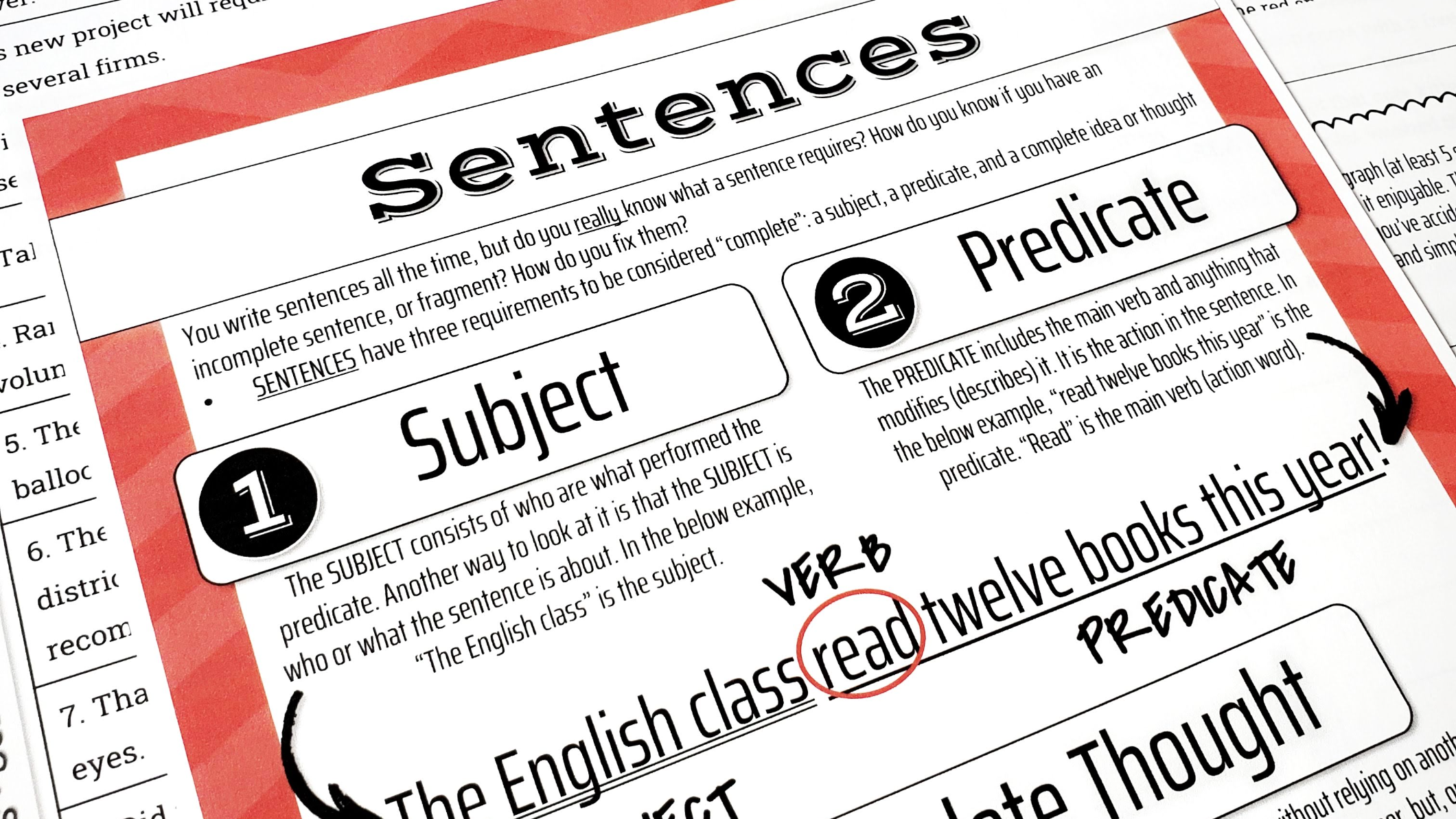
My Active and Passive Voice Writing Skills Lesson includes eight student worksheets.
1. Pre-thinking & Finding The Doer: Students complete the pre-thinking activity above and practice finding the doer of the action.
2. Active vs. Passive Voice: Students determine if a series of sentences are written in active voice or passive voice.
3. Passive Voice Conversion Exercise: Students are given active voice sentences and must rewrite them using passive voice.
4. Active Voice Conversion Exercise: Students are given passive voice sentences and must rewrite them using active voice.

5. Passive Voice Exercises: Students must match several passive voice sentences to the reasons they are written in passive voice. Then, students must write their own passive sentence and give a detailed explanation as to why passive is the right voice choice for that sentence.
6. Active Voice Writing: Students write their own active sentences. Then, a partner rewrites the sentences in their passive forms.
7. Passive Voice Writing: Students write their own passive sentences. Then, a partner rewrite the sentences in their active forms.
8. Writing: Students write their own paragraph. They must use a variety of sentences including at least one passive voice sentence.
(These worksheets come in PDF format and editable Google Doc versions. They also include an answer key.)
Assessing Active and Passive Voice
While active and passive voice worksheets are great for regular practice, they might not be what you need for assessment.
I always recommend assessing informally as you go. This might be as simple as talking with students while they work on their worksheets. Or you might want to distribute exit tickets as you teach (my lesson includes three!).
You might choose a simple quiz or a large essay.
Of course, the best way to assess active and passive voice is to have students create their own writing.
The final worksheet in my Active and Passive Voice Lesson has students do this.
But you could also just add an active/passive voice requirement to the next essay you have students write. Try adding a section to their final rubric that requires at least 80% of the essay to be written in active voice. Or ask them to highlight the sentences in their essay that are written in passive voice.
You could even have students identify one another’s active and passive voice sentences during peer-editing.
Once you teach students how to use active and passive voice, don’t just shelve the idea. Make it part of your regular instruction. Keep reviewing it, bringing it up, and work the concept into ongoing writing and projects.

Active and Passive Voice Worksheets for High School: Conclusion
Whether you’re teaching 6th grade English language arts or 12th grade composition, active and passive voice are must-have techniques for your students to have in their toolbox. If we are to teach students how to become real-world writers, mastering active and passive voice are essential skills.
If you want to make teaching active and passive voice as easy as possible, grab my Active and Passive Voice Writing Skills Lesson here!