
Mastering semicolon use can help students write smoother, more sophisticated sentences. But before you dive into a full semicolon lesson, you need to ensure your students are ready.
In this post, I’ll break down why teaching semicolons matters, how to tell if students are prepared, and the easiest way to introduce semicolon rules.
Just looking for a quick Semicolon Lesson you can use tomorrow? Then, grab my Semicolon Less here, complete with slideshow, student handout, exit ticket, worksheets, and more!

Why Teach Semicolons?
Semicolons are one of the most misunderstood punctuation marks in the English language.
However, they serve an important function in writing, especially when it comes to joining related independent clauses. Teaching students to use semicolons correctly can help them avoid common errors like the comma splice and create a smoother transition between ideas.
The most common uses of semicolons–and the ones you will want to cover in your semicolon lesson–include:
- Connecting related sentences without using a coordinating conjunction.
- Separating items in a complex list that already contains commas.
- Improving clarity when writing compound sentences with conjunctive adverbs.
For example, in the following sentence, a semicolon helps clarify the relationship between the two independent clauses:
Some students struggle with punctuation; others pick it up quickly.
Without a semicolon, readers might mistakenly use a comma, leading to a comma splice. Of course, a full stop with a capital letter is another option. But semicolons allow for a closer connection between thoughts.
Teaching students how to master semicolons won’t just help them avoid grammatical mistakes; teaching semicolons can help students master their own writing voice. If they can learn to flawlessly wield a semicolon, students will be more able to guide their readers and create engaging writing.
How to Know If Students Are Ready for Semicolons
I think one of the hardest things about teaching grammar is understanding how to sequence grammatical concepts.
Not sure if your students are ready for semicolons? Ask yourself, “Are they writing in complete sentences?” If not, you might need to backtrack a little.
Before introducing semicolon rules, students should already have a solid grasp of:
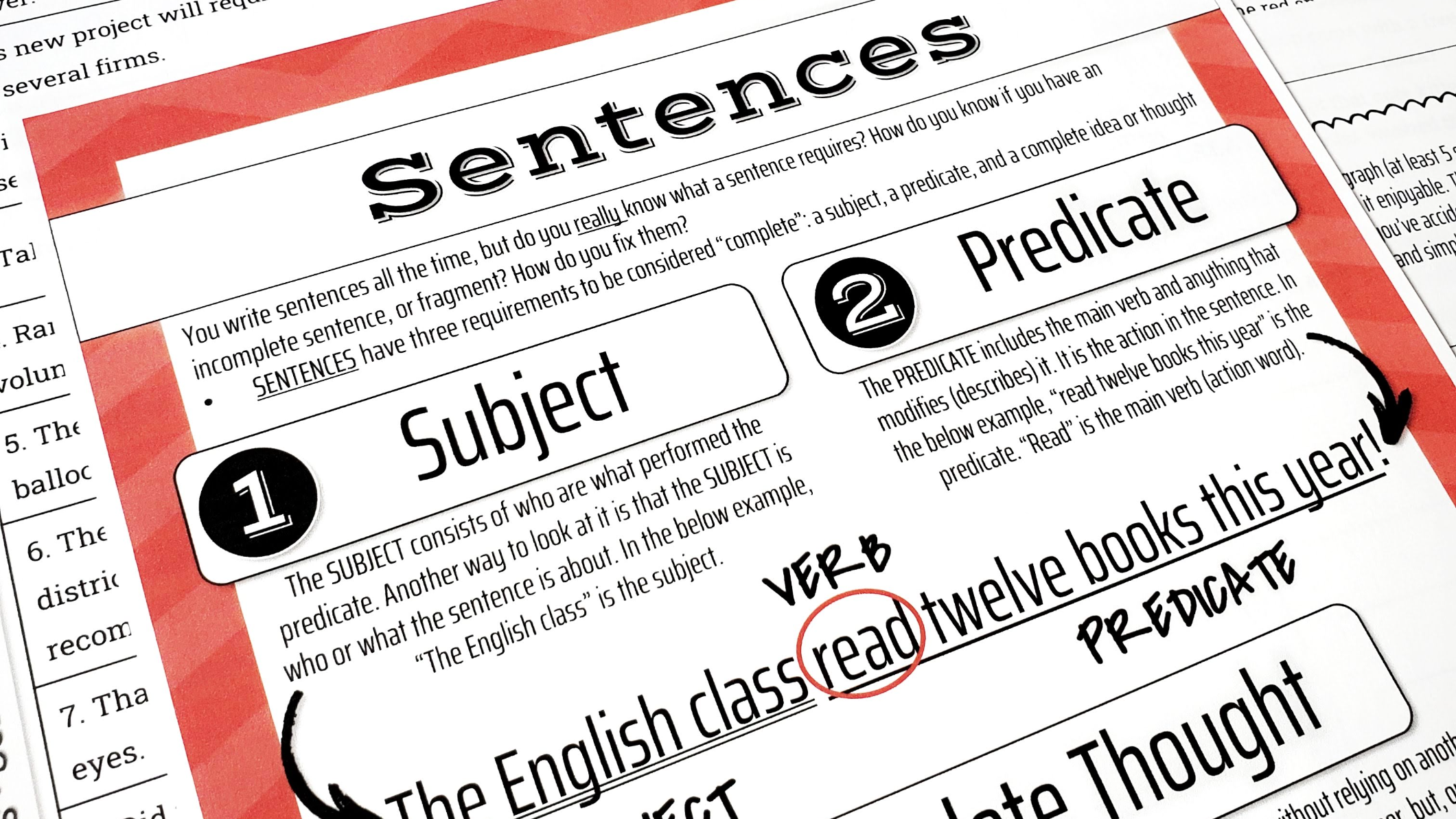
- Identifying a complete sentence (subject and predicate).
- Differentiating between an independent clause (main clause) and a dependent clause (second clause).
- Understanding the role of coordinating conjunctions.
- Recognizing parts of a sentence like noun phrases, prepositional phrases, and subject complements.
As long as students understand the basics of sentence structure, you’re ready to teach semicolons!
However, the semicolon doesn’t have to be the first punctuation mark you cover after sentence structure either. Personally, I like to cover the apostrophe and the colon before moving onto semicolons.
If time isn’t on your side, however, and you really want to hit that semicolon learning standard, then by all means! Jump into semicolons right after sentence structure.
If students still struggle with these concepts, a mini-lesson on sentence structure might be necessary before diving into semicolon use. Direct instruction on related grammar concepts will make your semicolon lesson more effective.

The Easiest Way to Structure Your Semicolon Lesson
1. Get a Feel For What Your Students Already Know

Try an informal pre-assessment with semicolons.
This could be as simple as asking your class, “What do you know about semicolons?”
See if they know what the piece of punctuation looks like. (I was shocked at how many of my high school kids mixed them up with colons. Believe it or not, I began starting all of my punctuation lessons quizzing students on what each piece of punctuation looked like.)
In my Semicolon Lesson, I include a pre-thinking activity on a worksheet.
Feel out your students before you get started. (If you need a very formal grammar assessment, check out my Grammar Pre-assessment, Mid-assessment, and Post-assessment here!)
2. Start with Direct Instruction
Nothing beats direct instruction.
Begin your lesson with clear explanations and examples of semicolon use. Ted-Ed animations and Khan Academy videos can be great tools to introduce semicolons in an engaging way.
Go through each use of the semicolon slowly. Provide lots of examples. You could even break down each of the uses of semicolons into their own mini-lessons!
3. Show Examples of a Semicolon in Use
Give students multiple examples of semicolons connecting related independent clauses, separating list items in a complex list, and appearing before a conjunctive adverb. Highlight the first word after the semicolon, emphasizing whether it needs a capital letter.
You can never have too many examples!
4. Use Mini Lessons to Reinforce Learning
Break down semicolon use into digestible mini-lessons. One day, focus on using semicolons to fix comma splices; the next, practice semicolons in a list of items. Providing multiple opportunities to engage with semicolon rules will help students internalize them.
In my Semicolon Lesson, students will learn about one semicolon rule. Then, they’ll pause for various practice activities. Only once they’ve applied one semicolon rule will they learn about the next.
5. Provide Guided Practice
Give students practice sentences and ask them to add semicolons correctly. Use real-world examples, like quotations from books or articles, to show how semicolons appear in published writing.
In my Semicolon Lesson, I provide several practice worksheets for students. Mix up how you have students practice–give them time for both independent practice and small group work.
6. Let Students Experiment in Their Own Writing
Have students rewrite sentences that contain punctuation errors, challenging them to use semicolons where appropriate. Encourage them to incorporate semicolons in their own writing, whether in essays, creative writing, or journal responses.
If necessary, you could make using semicolons a requirement in their writing. Maybe their next essay must have at least two sentences using semicolons. Or maybe they need to use a semicolon in a poem to force the reader to pause for a breath.
7. Wrap Up with an Assessment or Reflection
As with any new concept, make sure you have a plan for assessment.
This can be very informal. Those semicolon worksheets you used? They could themselves be an assessment.
In my Semicolon Lesson, I provide exit tickets. These could be another quick, informal form of assessment.

A fun idea could be a semicolon scavenger hunt. Can they find semicolons out in the wild (AKA the real world)? Can they explain how they’re being used? And, as a bonus, can your students find semicolon errors in real-world writing?
For a more formal–but equally quick–assessment, try this Semicolon Quiz.
You could also have students complete a reflection. Your assessment could be as simple as asking students, “What have you learned about semicolons?”
The answers might be eye-opening and provide you with new guidance for making your semicolon lesson for next year.

Semicolon Lesson Tips
Just as with anything else you teach, don’t forget to make your lesson accessible for all of your students. While we might expect semicolon use to be mostly review for high school students, if you have struggling learners, some of this will be new!
Make sure you teach slowly and provide scaffolds along the way.
I include a student handout in my Semicolon Lesson to which students can easily refer. You could make your students take notes so that they have the information readily available if they need a review. Even adding a poster to your room with a list of punctuation marks and their names could be helpful.
You know your students. Offer whatever supports you think will help them be successful.
After Your Semicolon Lesson
Once your students have become semicolon masters, it’s time to move on to harder pieces of punctuation!
If they haven’t learned about colons yet, those are next. Because semicolons and colons are easily and frequently mixed up, I recommend spending some time just practicing using them both.
Then, consider moving on to commas–the trickiest punctuation mark there is!
Conclusion
Teaching semicolons doesn’t have to be overwhelming.
By ensuring students have a strong foundation in sentence structure, using engaging resources, and providing plenty of guided practice, you can help students master semicolon use.
With well-structured mini-lessons and opportunities to apply their knowledge in their own writing, high school students will gain confidence in using this important punctuation mark. Keep reinforcing semicolon rules, and soon your students will be using them with ease!
Need a ready-to-go Semicolon Lesson that includes everything? Grab this Semicolon Lesson for a slideshow, student handout, several worksheets, exit tickets, and more!