Teaching sentence variety can be so frustrating! But we teachers know that if our students could just master them, they would master so much more: clauses, sentence structure, and sentence variety. If you don’t feel like a sentence structure expert yourself, though, it can be tough to put together and explain solid examples. In this post, I’m going to share some simple, compound, and complex sentence examples you can use in your classroom lessons.
Need more? I have a helpful blog on teaching sentence structure here and another here about teaching clauses.
I also have this done-for-you Clauses and Sentence Types Lesson that includes everything you need to teach! Inside you’ll find plenty of examples across a slideshow lesson, reference handout, worksheet, exit tickets, and more!

Why Teach Sentence Types?
I know, I know. Teaching sentence types can be such a drag. Students struggle to remember the different names. Clauses are hard. Conjunctions are a whole thing.
I get it.

But, if you can find the time to really help students master sentence types, you’ll be helping them do a lot more than just label a sentence simple or complex.
Understanding the different types of sentences is an effective way to improve writing clarity and variety.
If you want students to develop strong writing skills, teaching sentence types is essential. Understanding sentence structure helps students write with clarity, avoid run-on sentences and sentence fragments, and add variety to their writing.
(And remember–the better your students write, the less time you spend grading those long papers.)
By recognizing the different types of sentences, students can:
- Improve their ability to express complete thoughts effectively.
- Use a variety of sentence types to create engaging and well-structured writing.
- Avoid common grammatical errors, such as run-on sentences and sentence fragments.
- Enhance their analytical skills by identifying independent and subordinate clauses in complex sentences.
- Strengthen their reading comprehension by understanding how authors use sentence structure for emphasis and meaning.
If you’re new to teaching sentence types and feeling a little overwhelmed, don’t worry!
You can grab my Clauses and Sentence Types Lesson here and teach with confidence! I’ll also walk you through the different sentence types in this blog post.
The four main types of sentences include simple sentences, compound sentences, complex sentences, and compound-complex sentences. Below, we’ll break down each type with definitions and examples to illustrate their sentence structure.
Simple Sentence Overview
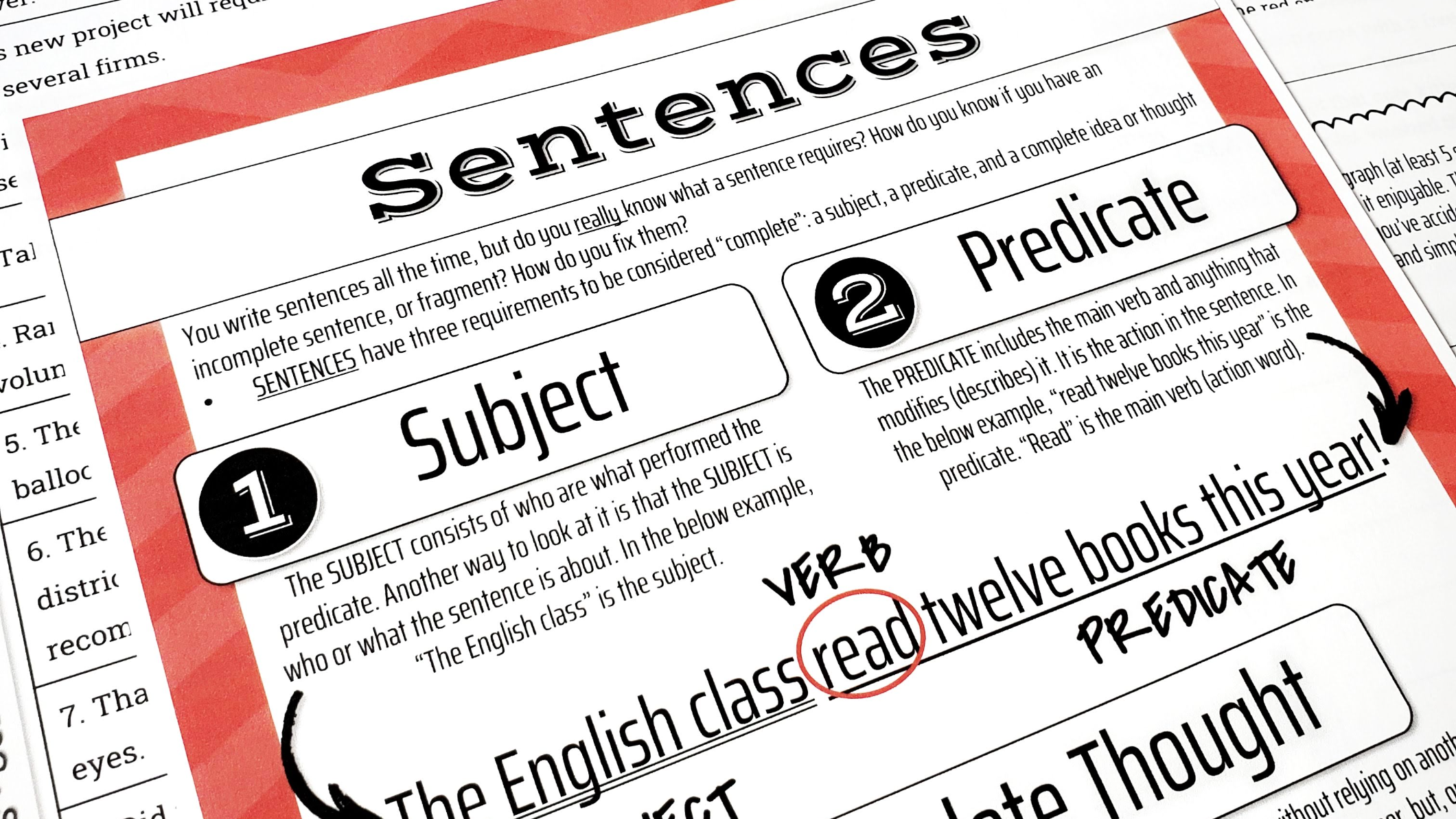
A simple sentence consists of one independent clause.
An independent clause is a group of words that expresses a complete thought and contains a subject and a main verb. Simple sentences are, well, simple.
Even though a simple sentence has just one clause, it can still have compound elements such as a compound subject or compound verbs. Watch out for these!
Compound subjects and compound verbs trip students up all the time! They might see a compound subject and think there are two clauses when there’s only one.
Simple Sentence Examples:
- The dog barked. (Single subject and single verb)
- The cat and the dog played in the yard. (Compound subject)
- She ran and jumped over the hurdle. (Compound verbs)
- The boy in the blue jacket waved. (Includes a prepositional phrase)
Simple sentences are an effective way to communicate a complete idea without extra detail that might confuse the reader.
FANBOYS Coordinating Conjunctions
A compound sentence is created when two independent clauses are joined together.

When you introduce compound sentences (more on those below), you’ll also need to introduce coordinating conjunctions.
The great thing about coordinating conjunctions is that there are not too many! Our students will still forget them, however.
Help your students keep track of the coordinating conjunctions with this FREE Coordinating Conjunctions Poster!
The coordinating conjunctions can be remembered with the acronym FANBOYS:
- For
- And
- Nor
- But
- Or
- Yet
- So
These conjunctions connect independent clauses to form compound sentences while maintaining the sentence’s structure.
Compound Sentence Overview
One of the main types of sentences that require a coordinating conjunction is the compound sentence.
A compound sentence consists of two independent clauses joined by a coordinating conjunction or a conjunctive adverb.
The first things to remember when forming a compound sentence are that each clause should express a complete thought and the coordinating conjunction should be properly placed.
Really emphasize for your students that coordinating conjunctions are preceded by commas. I go so far as to mark entire sentences wrong on their worksheets if they miss these important punctuation marks.
Compound Sentence Examples:
- I wanted to go for a run, but it started raining.
- She likes to read novels, so she visits the library often.
- We could go to the movies, or we could stay home and watch TV.
- He didn’t study for the test; therefore, he didn’t pass. (Example using a conjunctive adverb)
If the coordinating conjunction is missing, the result is a run-on sentence or sentence fragments instead of a complete sentence.
Again, this is a point that should be really emphasized for students. Independent clauses joined together with a comma but no coordinating conjunction are comma splices. I always mark these types of run-on sentences wrong and ask students to make corrections.

Complex Sentence Overview
A complex sentence contains one independent clause and at least one dependent clause.
A dependent clause, also called a subordinate clause, does not express a complete thought and needs to be attached to a main clause to make complete sense.
These sentences often use subordinating conjunctions or relative pronouns to introduce the dependent clause.
When I break down sentences for students, conjunctions often confuse them. I do not count coordinating conjunctions as “part” of an independent clause, but I do count subordinating conjunctions as “part” of a dependent clause. This helps to show students why a dependent clause is not a complete thought.
(This is also a great time to explain to students why teachers tell them not to start a sentence with “because,” even though it can be done correctly! After teaching complex sentences, I tell my students they can start sentences with “because”–if they can explain why to me.)
Complex Sentence Examples:
- Although it was raining, we still went to the park. (Subordinating conjunction: Although)
- She stayed inside because she was feeling sick. (Because introduces the subordinate clause)
- The book that I borrowed was fascinating. (Relative pronoun: that)
- Whenever I hear that song, I think of summer. (Subordinating conjunction: Whenever)
Complex sentences allow writers to add extra information to their writing without creating run-on sentences.
Again, make sure students pay really close attention to how these sentences are punctuated. When a sentence starts with a dependent clause, that clause needs to be followed by a comma. However, if the sentence ends with a dependent clause, no comma is needed.

Compound-Complex Sentence Overview
A compound-complex sentence structure combines elements of both compound and complex sentences. This type of sentence contains at least two independent clauses and one or more subordinate clauses.
Make sure students are careful of punctuation here. All previous rules about commas still apply to compound-complex sentences.
You’ll also want to show students examples of dependent clauses (that start with relative pronouns) “interrupting” independent clauses. See the second example below.
Compound-Complex Sentence Examples:
- While I was studying, my friends went to the mall, and they watched a movie.
- The teacher explained the lesson, but the students, who were tired, struggled to focus.
- I enjoy playing basketball because it is fun, and it helps me stay active.
Using a variety of sentence types, including compound-complex sentence structures, is an effective way to enhance writing.
Final Thoughts
I hope these simple, compound, and complex sentence examples helped you feel more confident tackling sentence structure with your students.
Once your students have mastered all four sentence types, they’ll be able to fix run-on and fragment sentences. They’ll also be able to better understand punctuation use.
Recognizing the different types of clauses and how they form different types of sentences is key to mastering sentence structure.
Whether using task cards, anchor charts, or resources like Khan Academy, practicing these sentence structures helps writers avoid run-on sentences and sentence fragments while improving clarity. By analyzing their own sentences, writers can ensure they use a variety of sentence types to create engaging and grammatically correct writing.
If you’re feeling intimidated and want some support teaching sentence types, grab my Clauses and Sentence Types Lesson. You can teach using the slideshow filled with examples and explanations. Trust me, the more you teach this lesson, the more comfortable you will be with analyzing sentence types yourself!