Teaching punctuation and grammar to high school students can feel like an uphill battle. Many students tune out at the mention of “complex sentences” or “independent clauses.” But the right activities can turn grammar lessons from a snooze fest into an engaging and effective learning experience.
In this post, I’m going to list some ways to incorporate grammar into your classroom. From standard direct instructions to magnet tiles, I’m sure you’ll find something that suits you and your students!
Whether you’re preparing for test prep, reinforcing sentence structure, or integrating grammar into writing activities, these strategies will help you build essential literacy skills in a fun way.
Just need a grammar curriculum that works–without spending time on the fluff? Grab my Year-long Grammar Curriculum here and save yourself hours!
Disclosure: This post may contain affiliate links that earn me a small commission, at no additional cost to you. I only recommend products that I personally use and love, or think my readers will find useful.

Punctuation and Grammar Activities #1: Direct Instruction with Mini-Lessons
While we love hands-on activities and getting students moving, nothing beats old-fashioned direct instruction–especially when it comes to grammar.

Before jumping into hands-on activities, direct instruction with mini-lessons can provide students with a solid foundation in grammar skills. A short, focused lesson on a specific topic—such as possessive apostrophes, independent clauses, or proper punctuation—helps students understand the rules before applying them.
Use engaging slideshows, grammar worksheets, or video clips to introduce concepts. Keep this part short! You don’t want to list out every comma rule before giving students time to practice them!
Then, follow up with guided practice where students complete sentence structure exercises together before moving on to independent practice. These mini-lessons can be part of your daily bell ringers or weekly lessons, reinforcing grammar skills in manageable chunks.
Looking for lessons that do exactly this? Check out my Grammar and Punctuation Lessons! Each includes a slideshow that breaks concepts down into manageable chunks. After teaching each “chunk,” students will complete the included exercises to build on their skills.
Punctuation and Grammar Activities #2: Illustrated Grammar Activities
Visual aids can make abstract grammar concepts more concrete and provide scaffolds for struggling learners.

Consider all the ways you can make grammar visual for students. As a class, in groups, or independently, challenge students to create posters or anchor charts around grammatical concepts for your classroom.
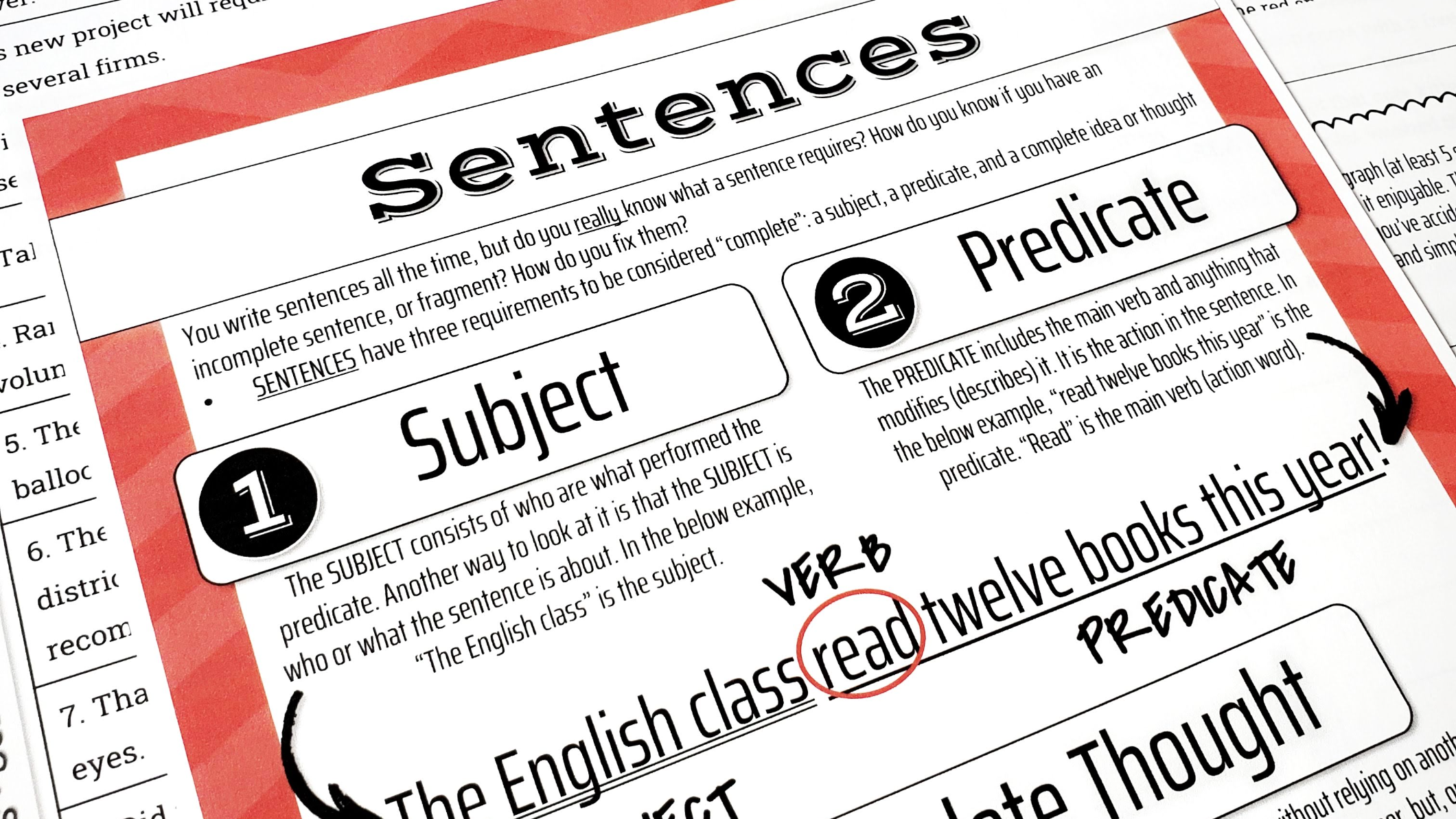
Include visual notes or handouts when you teach a grammatical concept. (All of these grammar lessons include a visual handout for students!)
Create sentence strips featuring different punctuation marks—such as question marks, exclamation points, and full stops—to help students visualize correct punctuation.
You could also try creating illustrated grammar activities where students match sentence types to their appropriate punctuation. For example, you can write a series of sentences with missing end marks and have students place the correct answer in the right place.
The more illustrated and visual you can make grammar, the easier concepts will be for students to remember. This is a great way to reinforce the importance of correct punctuation while keeping students engaged.
Want to check out my grammar handouts? Sign up for a free Parts of a Sentence Handout below!
Punctuation and Grammar Activities #3: Digital Grammar Activities
It seems like every day, there’s a new way to use technology to teach grammar.
Using an interactive book or digital grammar worksheets can provide an optimal experience for students who thrive with technology or need tech as a learning support. Many punctuation skills can be reinforced with digital activities that allow for instant feedback.

Have you made teaching grammar part of a Google Classroom workflow?
There are so many ways to use Google Doc activities to reinforce grammar skills!
You could have students share Docs and peer-edit one another’s work for incorrect punctuation, capital letters, and improper nouns.
Because Google will show you the work history, you’ll be able to see the Docs metamorphosis and each student’s success in editing another’s work. This method not only improves their grammar practice but also enhances their editing skills—an essential part of English Language Arts.
Don’t forget that you can use Google Forms for instant feedback too! All of my Grammar Quizzes and Assessments include Google Forms versions. The great thing about Google Forms is that they can self-grade. That means less work for you and instant feedback for students.
While I believe that handwriting and physically practicing punctuation is the best method for most grammar work, don’t completely disregard using digital grammar activities. They can challenge your students in a new way while saving you a ton of time on grading!
Punctuation and Grammar Activities #4: Task Cards for Small Groups and Independent Work
Task cards are a great tool for small groups or independent practice.
Each card can focus on different punctuation marks, proper punctuation placement, or sentence structure. You could make a different task card set for each grammatical concept or mix up all of your grammar topics in one deck for the ultimate review!
You can set up stations where students rotate through punctuation activities, identifying the correct ending punctuation marks or rewriting a sentence in the correct order.
For a more collaborative approach, have students work in pairs to correct sentences on task cards. You can even gamify this by awarding points for every correct answer.
I’ve also turned task cards into scavenger hunts before. This is a great technique if you have antsy students that just need to get up and move!
Hang your task cards around the room in a random order. Then, give each student a worksheet to record their answers and a clipboard. Students will have to physically move around the room to find all of the questions in order to fill out the answers on their blank worksheet.
This approach makes grammar lessons interactive and effective for high school students.

Punctuation and Grammar Activities #5: Sentence Structure Exercises with Word and Punctuation Magnets
You know those magnet poetry tiles you probably had on your college dorm fridge? Bust them out and use them in class!
Sentence structure is a foundational skill in high school English. Using punctuation magnets on metal trays or handmade sentence cards on bulletin boards, students can construct sentences and experiment with different punctuation marks.
Find some (school appropriate) sets from your basement, friends’ houses, thrift stores, etc. and put them to use. You can find fun ones on Amazon, too, of course. (Check these ones out!)
You could even make some yourself!
Write sentence starters, enders, independent clauses, dependent clauses, conjunctions, and individual pieces of punctuation marks on index cards or cardstock. Then, let students mix-and-match the sentence parts to create their own sentences.
They can do this right on their desks, pin them to bulletin boards, or hang them up with tape.
This is a fun way to reinforce grammar techniques and show how punctuation affects meaning.
Punctuation and Grammar Activities #6: Writing Center Grammar Practice
If you have the space, consider creating a writing center in your classroom.

Your writing center can be a hub for grammar skills development. Provide grammar worksheets that focus on different sentence types, such as simple, compound, and complex sentences. Include sentence strips that students must arrange in the correct order to form a grammatically sound paragraph.
Make sure your writing center has everything students will need: different colored pens for editing, sticky notes, and a list of punctuation marks and their rules. You could even leave some dictionaries, thesauruses, and grammar references there.
If you utilize stations in your classroom, this will be the perfect place for students to peer-edit! Have students swap papers and check for correct punctuation, sentence structure, and proper nouns. This reinforces grammar skills while preparing students for independent editing and revision.
Punctuation and Grammar Activities #7: Weekly Newsletter and Social Media Grammar Challenges
If you’re the kind of teacher who utilizes a weekly newsletter or public social media for your students or their families (kudos to you–I could never!), use those spaces to add some grammar!
Consider incorporating grammar practice into your weekly newsletter or social media pages. Challenge students with a “Fix the Sentence” post where they identify errors in a poorly written sentence. Post pictures of funny typos found around town. Challenge them to spot the mistake in your newsletter!
Engaging students outside of the classroom with fun grammar challenges can help reinforce learning in different ways.

Punctuation and Grammar Activities #8: Standards-Based Lessons and Test Prep
Ok, maybe this one isn’t quite as fun as some of the other suggestions, but lessons and tests have to happen, too!
Your grammar instruction should align with Common Core and state standards. (Personally, I recommend my own Grammar Curriculum!)
A standards-based lesson focusing on punctuation and grammar activities ensures students are prepared for standardized tests. In my lessons, I include a slideshow, worksheets, exit tickets, student reference handout, lesson plan, and answer keys. They teach concepts in short bursts before having students practice.
For test prep, use grammar worksheets that require students to correct errors in a passage. This mirrors the types of questions found in exams and strengthens their ability to apply grammar rules under pressure.
If you know that your students will be taking the ACT, pull questions from old ACT tests. Do the same for the SAT or any other standardized test that students are required to take.
If you have to review grammar anyway, you might as well expose students to what they can expect on those high-stakes tests.
Punctuation and Grammar Activities #9: Digital Grammar Tools
I mentioned using Google Classroom above, but don’t forget about the other growing list of digital grammar tools out there.
Platforms like IXL Learning, Quill.org, and NoRedInk offer individualized grammar practice based on student performance. Personally, I tried Quill.org and NoRedInk with my own students and didn’t see a lot of success. (Students got bored and lost their focus after just a few lessons.) But they could be great for quick assessments, one-off lessons, or sub plans.
Sometimes students just need something a little different to re-engage them into their grammar work.
Punctuation and Grammar Activities #10: Cross-Curricular Grammar Applications
The magic really happens for grammar when students can see that it’s used outside of the ELA classroom.
See if your school or team are open to using the same grammar standards, expectations, or rubrics. Even using the same language can benefit students. If their physical science and social studies teachers are asking for sentences that contain “subjects, predicates, and complete thought,” they’re going to listen more when you use those terms.
Grammar isn’t just for English lessons! Encourage your colleagues to get students writing with high grammar expectations. For example, have students write historical narratives about Native Americans while focusing on proper punctuation and sentence structure.
This cross-curricular approach not only strengthens grammar skills but also reinforces literacy skills across different subjects.
Conclusion
Effective punctuation and grammar instruction doesn’t have to be dry and repetitive. By incorporating illustrated grammar activities, task cards, sentence structure exercises, and digital tools, you can create an engaging learning environment that supports literacy skills.
Whether through independent work, small groups, or classroom activities, giving students a variety of grammar practice opportunities will help them develop stronger writing skills.
Ready to transform your grammar lessons? Check out my High School Grammar Year-Long Bundle for a comprehensive set of resources that make teaching punctuation and grammar a breeze!
